
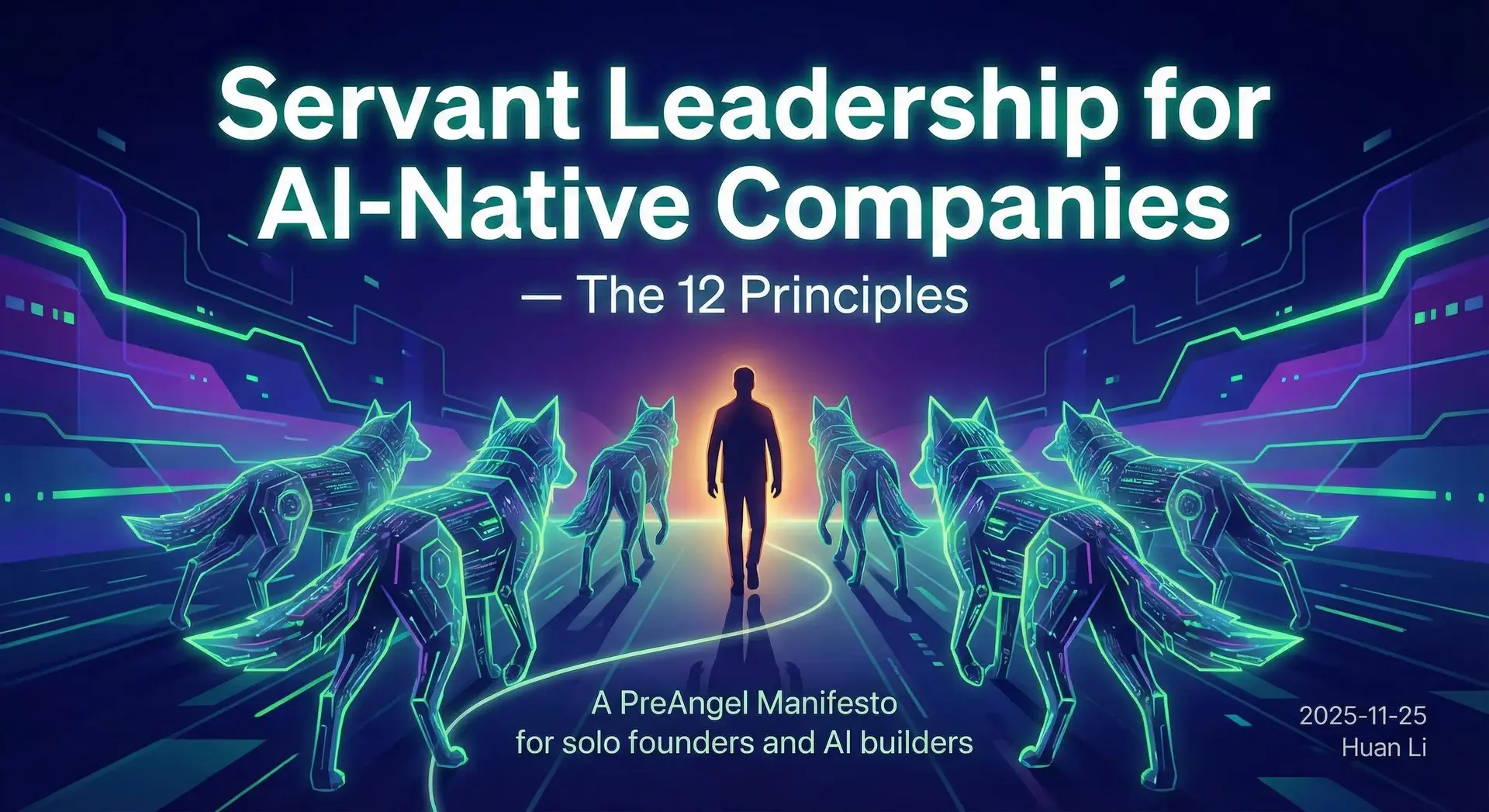

Servant-leadership is all about making the goals clear and then rolling your sleeves up and doing whatever it takes to help people win. In that situation, they don’t work for you, you work for them. —— Ken Blanchard
The story actually started in a very 2025 way: I was scrolling Facebook.
Somebody had shared a post about how a wolf pack moves through the snow. Not the usual “alpha in the front” macho story — the exact opposite.
The post explained that:
- At the very front walk the old or weaker wolves. They are not there to be sacrificed; they set the pace of the whole pack, so no one gets left behind.
- Behind them come some of the strongest wolves, acting as a front-line defense if danger appears from ahead.
- The majority of the pack stays safely in the middle, protected on all sides.
- At the very back are more strong wolves, guarding the rear.
- And the true leader? They walk last, where they can see everyone, keep the formation together, and rush forward or backward wherever they are needed most.
That post hit me hard.
It quietly rewired my mental model of leadership:
Real leaders don’t race ahead to prove they are fast. They walk last to make sure everyone arrives.
And then my brain did what it always does: it mapped this straight into the world of AI‑native companies.
If my “team” is now a constellation of AI agents—coding, designing, planning, summarizing, running experiments—what does it mean to be the “last wolf”?
- I’m not the one writing every line of code.
- I’m not the one drafting every doc or designing every screen.
- I’m the one watching the whole formation: the users at the front, the agents working in the middle, the infrastructure defending the edges.
In that moment, servant leadership stopped feeling like a soft HR concept and started feeling like the operating system for a one‑person, AI‑native incubator.
This manifesto is my attempt to turn that wolf‑pack insight into a practical framework for solo founders and AI‑native builders — with or without a deep technical background — who are building companies where:
- one human walks last,
- many AI co‑founders run ahead,
- and the whole pack moves forward together.
1. Serve Clarity, Not Tasks
In an AI‑native company, your AI is never “lazy” — it is just under‑specified.
Traditional leaders assign tasks. Servant leaders create clarity.
Your AI co‑founder needs:
- A clear goal (What are we trying to achieve?)
- A clear user (Who is this for?)
- A clear constraint (What is out of scope?)
- A clear definition of done (How do we know it’s good?)
Try this: Before asking your AI to “build a landing page,” send a clarity packet:
- 1–2 sentence product pitch
- Target user
- Promise / transformation
- Tone (serious, playful, founder‑to‑founder, etc.)
- 1 example you love and why
Servant leadership means you do the hard thinking so the AI can do the heavy lifting.
2. Design the Playground, Not the Moves
You don’t scale by micromanaging every prompt. You scale by designing playgrounds where AI agents can safely explore.
Playgrounds are made of:
- Constraints (What’s allowed?)
- APIs / tools (What can agents do?)
- Guardrails (What must never happen?)
- Templates (How does output normally look?)
The more thoughtfully you design the playground, the more aggressively your AI can explore inside it.
For non‑technical founders: your playground might be a set of structured Google Docs, Notion spaces, or simple checklists.
For technical founders: your playground might be MCP servers, typed APIs, and a good README.md your agents can read.
Either way, servant leadership says:
“I don’t choreograph every step. I design the dance floor.”
3. Treat AI as a Co‑Founder, Not as a Tool
If you treat AI like a smart intern, you will:
- Under‑delegate
- Over‑explain
- Waste its potential
If you treat AI like a co‑founder, you will:
- Ask for opinions, not just outputs
- Explore multiple directions in parallel
- Let it challenge your assumptions
Example prompts:
- “Propose three radically different go‑to‑market strategies for this product. Assume I’m comfortable being weird.”
- “What are the top 5 ways this idea could fail? Be brutally honest.”
Servant leadership here means:
You invite your AI to think with you, not just work for you.
4. Make the Invisible Legible (Memory is a First‑Class Product)
AI agents are powerful, but forgetful.
They don’t have institutional memory unless you build it.
Servant leadership for AI means:
- Documenting decisions in a way agents can read (Markdown, structured notes)
- Organizing repos, folders, and docs so they are machine‑navigable
-
Creating simple “source of truth” docs for:
- Brand voice
- Product positioning
- Architecture diagrams
- Playbooks and checklists
Your job is to make the invisible context of your brain visible and legible to your AI co‑founders.
In an AI‑native company, documentation isn’t bureaucracy. It’s oxygen.
5. Remove Friction Ruthlessly
You don’t motivate AI with pep talks. You empower it by removing friction.
Friction for AI looks like:
- Missing API keys or credentials
- Broken dev environments
- Untested prompts scattered across random chats
- Inconsistent file structures
- Context limits constantly hit because everything is messy
Servant leadership means you:
- Standardize project layouts
- Centralize environment setup
- Turn “one‑off hacks” into repeatable tools
- Continuously upgrade your agents’ toolbelts
Every time you think, “I’ve wired this together twice,” that’s your cue to productize it for your agents.
6. Be the Vision Oracle (Taste is Your Real Job)
Your AI can generate 1,000 versions of anything. Only you can say:
- “This one feels like us.”
- “This is on‑brand, the others are not.”
- “This is the kind of company I want to build.”
Servant leadership does not mean letting the AI decide everything. It means:
- You hold the north star
- You curate from the infinite menu of options the AI gives you
- You say “no” a lot
In an AI‑native startup, your taste, ethics, and story are the hardest things to copy. Protect them. Refine them. Teach them to your AI.
Try this:
Start a vision.md or taste.md where you:
- Paste examples you love
- Annotate why you love them
- Paste things you don’t like and explain why not
Let your AI co‑founder read that before doing creative work.
7. Default to Parallel Experiments
The old world:
“We have one team. They build one version at a time.”
The AI‑native world:
“We have one human, many agents. They explore many branches at once.”
Servant leadership in this context means:
- You design experiments, not tasks
- You let agents explore multiple directions in parallel
- You compare, select, and recombine the best pieces
Examples:
- 5 variants of the landing page hero
- 3 different pricing pages
- 4 copies of onboarding flows tailored to different archetypes
- 2 architecture options for the same feature
You’re not being indecisive; you’re using your AI co‑founder as a search engine over the space of possibilities.
8. Ship Tiny, Ship Often
AI makes it cheap to build. That doesn’t automatically make it cheap to ship.
Shipping still requires:
- Decisions
- Integration
- QA (even if AI‑assisted)
- Talking to real users
Servant leadership means you protect the feedback loop:
- Small scope → Real user → Learn → Iterate
Instead of asking your AI:
- “Build the whole product”
Ask:
- “Help me ship a testable slice in 48 hours that a real user can touch.”
You serve the system by respecting reality: real users, real usage, real constraints.
9. Hold the Bar, Not the Keyboard
You don’t win by doing the work yourself. You win by holding the bar for what “good” means.
Servant leadership with AI looks like:
- Letting AI write the first draft of everything
- But refusing to ship unexamined work
- Creating checklists: “What must be true before we call this done?”
For example:
- Every outbound email: checked for tone, clarity, and risk
- Every architecture change: sanity‑checked against future constraints
- Every pricing page: run through at least one user persona walkthrough
You serve your AI co‑founders by giving them clear quality standards and then enforcing them.
10. Build Ethics and Safety into the Loop
AI makes it easy to scale impact — and mistakes.
Servant leadership here means you:
- Take responsibility for the harm your system could cause
- Bake guardrails into prompts, tools, and workflows
- Refuse shortcuts that trade user trust for short‑term metrics
Questions to ask often:
- “If this scales to a million users, what could go wrong?”
- “How can we design this so the safest behavior is the default?”
- “What’s the most respectful way to treat the humans in this loop?”
Your AI co‑founders will happily optimize what you ask them to optimize. Your job is to choose those objectives carefully.
11. Invest in Systems, Not Heroics
One‑off cleverness doesn’t scale you. Systems do.
For a one‑person AI‑native incubator, servant leadership means you constantly ask:
- “Can I turn this into a reusable workflow?”
- “Can I give my AI co‑founders a button instead of a story?”
- “Can this become a template, a script, a devcontainer, a macro, an MCP tool?”
You are not just building products. You are building an AI‑first factory that can ship many products over time.
PreAngel is precisely this idea:
a solo founder surrounded by a growing fleet of AI systems and playbooks.
12. Protect Your Human Energy (You Are the Scarce Resource)
In an AI‑native company, you — the human — are the rarest resource in the system.
Your:
- Judgment
- Curiosity
- Emotional resilience
- Relationship with users
- Long‑term vision
These cannot be replaced.
Servant leadership includes serving yourself:
- Design workflows that don’t burn you out
- Let AI carry the cognitive load when you’re tired
- Use agents to manage context so you can think higher‑level
- Say no to ideas that don’t align with your deepest “why”
You’re not just a manager of machines. You’re the founding human of something that could outlive you. Treat your energy like part of the core architecture.
Putting It All Together: The Human + AI Servant Leadership Loop
Here’s the loop I use and recommend for AI‑native solo founders:
- Clarify the goal, constraints, and user
- Design a small experiment or playground
- Delegate aggressively to AI agents
- Compare outputs across branches
- Curate based on your vision and taste
- Ship a tiny but real slice to users
- Reflect on the results and document what you learned
- Refine your systems, tools, and guardrails
Then you repeat — faster each time, with a richer AI environment.
Over time, your company becomes less about what you can do today and more about:
What your human–AI system is now capable of doing on your behalf.
That’s the real leverage.
A Closing Invitation to AI‑Native Solo Founders
If any of this resonates, you’re probably already sensing the shift:
- from “I need a big team” → to “I need a strong system.”
- from “I must do everything myself” → to “I must design how everything gets done.”
- from “AI is a tool” → to “AI is my co‑founder.”
Servant leadership for AI‑native companies is not theoretical. It’s a daily practice of:
- serving clarity
- serving systems
- serving the humans your product touches
As PreAngel grows, this is the framework I’ll keep refining and sharing: how a single human, with a constellation of AI co‑founders, can build companies that once required entire org charts.
If you’re building something like this yourself, I’d love to hear your story.
What does servant leadership look like in your human + AI company?
Let’s learn from each other — and teach our digital wolves to build a better future, together.
 How a Non-Technical CEO Rebuilt a Video AI Platform in 30 Days